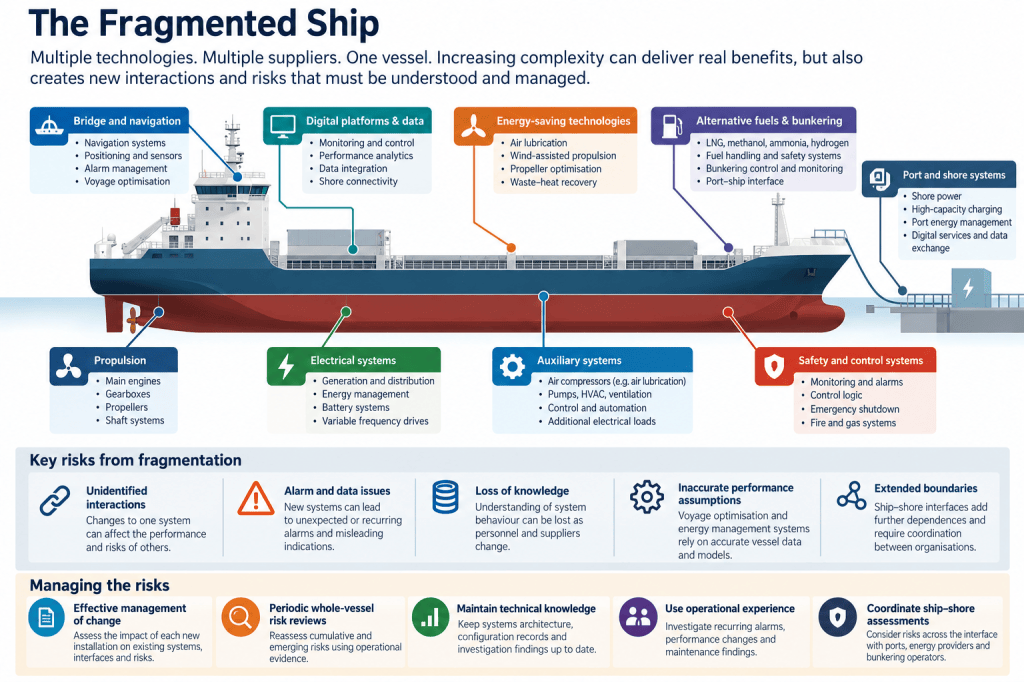
How successive technological changes can alter a vessel’s risk profile throughout its working life
A Psi-DN Perspective | Maritime Engineering, Technology and Risk
During a maritime cybersecurity risk assessment a while ago, I encountered a problem that has stayed with me. Responsibility for IT and operational technology (OT) aboard vessels was divided between technical departments and specialist suppliers. Individual systems were generally understood by those responsible for them, but there was less clarity around their connections, dependencies and the consequences of making changes.
Among the recommendations made were clearer technical accountability, a common approach to managing IT and OT risks, and a vessel-specific systems architecture identifying the equipment, interfaces and dependencies.
A recent discussion about fragmentation in maritime digitalisation reminded me of that assessment. It also made me think about how the introduction of new technologies can change a vessel’s overall risk profile, particularly where successive modifications create dependencies between systems that were originally designed or assessed separately.
Over its working life, a vessel may undergo numerous modifications to improve efficiency, reduce emissions, meet regulatory requirements or extend its commercial usefulness. Many of these changes involve technologies that were unavailable or commercially unviable when the vessel was designed.
Air lubrication systems, wind-assisted propulsion, battery-hybrid installations, alternative fuels, propeller upgrades and increasingly sophisticated energy-management systems are finding their way aboard existing vessels. Each installation brings additional equipment, control arrangements, operating requirements and technical dependencies.
The installations may take place several years apart, often involving different manufacturers and specialist contractors. Each has its own design assumptions, commissioning requirements and expected performance benefits. The engineering implications extend beyond the equipment being installed, as do the potential risks.
An air lubrication system may reduce the frictional resistance of the hull and consequently the propulsion power required at a given speed. Wind-assisted propulsion can further reduce the thrust demanded from the propeller, changing main engine loading and potentially affecting its operating efficiency. The addition of compressors, electrical equipment and control systems also introduces new demands on the vessel’s auxiliary machinery and electrical distribution.
These interactions matter when evaluating performance and assessing risk. A propeller selected for an earlier operating profile may behave differently following changes to hull resistance or propulsion demand. Energy savings established during equipment trials may also change as further technologies are introduced. Changes to electrical loading, control arrangements and machinery operating conditions may affect the assumptions underlying previous risk assessments.
The cumulative effect depends on how the systems perform together under the vessel’s actual operating conditions. Establishing this requires reliable operating data, an understanding of the assumptions behind each installation and an assessment of the dependencies between them. There is also a practical issue concerning the technical knowledge retained by the operator.
Imagine a vessel that receives a new propeller during dry docking. Several years later, an air lubrication system is installed, followed by an upgraded energy-management system intended to improve electrical generation and auxiliary loading.
Each installation is completed by specialist contractors and commissioned against its respective requirements. The vessel returns to service and the equipment performs as expected. Over time, however, the engineers begin encountering intermittent alarms associated with electrical loading and machinery operating conditions. Some appear when the air compressors start, others during changes in propulsion demand. Occasionally, the monitoring system displays readings that seem inconsistent with the machinery’s observed behaviour.
The explanation could involve electrical transients, sensor calibration, alarm settings or the exchange of information between different control systems. Understanding the cause may require access to the original engineering assumptions, equipment configurations and subsequent modifications.
The Chief Engineer may know that a particular alarm has occurred repeatedly without any apparent machinery fault. An experienced electrician may have identified the operating conditions under which it appears. That knowledge is valuable, but it may never have been formally investigated or recorded. When those personnel leave, their successors inherit the same equipment and alarms, with limited understanding of their history.
Repeated unwanted alarms can gradually reduce confidence in the monitoring system. There is also the possibility that an apparently false indication reflects a genuine operating condition that was never anticipated when the system was configured.
The same problem can affect navigation, propulsion control and other equipment sharing sensors or exchanging operational information. As systems become more interconnected, investigating an unexpected indication may require expertise from several disciplines or suppliers.
“When those personnel leave, their successors inherit the same equipment and alarms, with limited understanding of their history.”
Over the course of a vessel’s life, technical knowledge can become dispersed across manufacturers, contractors, shore-based departments and successive crews. Drawings and manuals may remain available, but they rarely capture every engineering decision, operating limitation or lesson learned during years of service.
Successive modifications compound the problem, particularly where earlier design assumptions are no longer documented or the relationships between systems have changed. The resulting uncertainty can make it difficult to assess cumulative risk and determine whether existing controls remain appropriate for the vessel’s current configuration.
Digitalisation has considerable potential to improve this situation. Modern monitoring platforms can consolidate vessel data, identify performance trends and provide shore-based teams with better information about machinery condition and operational efficiency.
However, the reliability of the resulting analysis depends on the measurements and the models used to interpret them. A reduction in shaft power, for example, may be accompanied by changes in engine efficiency, auxiliary power consumption or vessel operating conditions. Several energy-saving technologies may contribute to an observed improvement, making it difficult to determine the benefit attributable to a particular installation.
Artificial intelligence and advanced analytics can help identify patterns in operational data, although engineering knowledge remains necessary to establish their significance and investigate the underlying causes.
The increasing use of voyage optimisation software introduces similar considerations. Routing recommendations rely on vessel performance models and operating assumptions. Changes to the hull, propulsion machinery or energy systems can affect the accuracy of these models, particularly where they have not been updated following modifications.
A related concern is emerging around the growing dependence of ships on shore-based infrastructure. Hybrid-electric ferries, for example, may rely on high-capacity charging during relatively short port turnarounds. Their operational performance depends on the compatibility of onboard battery-management equipment, shore charging systems and the electrical capacity available at the berth. A reduction in available charging power may affect the energy available for the next voyage and require changes to the vessel’s operating strategy.
Alternative-fuel bunkering introduces further dependencies between shipboard equipment, terminal installations, instrumentation, communications and emergency shutdown arrangements. Different organisations may be responsible for maintaining and operating individual parts of the installation.
These activities are subject to established regulatory and technical requirements, including the IEC/IEEE 80005 series for shore electrical connections and the IMO’s IGF Code and associated fuel-specific guidance. Nevertheless, the safe and effective operation of connected systems requires coordination between the parties responsible for their design, operation and maintenance. This has implications for the scope of engineering and risk assessments extending across the ship–shore interface.
The organisational arrangements aboard and ashore are equally important. Shipping companies divide technical responsibilities between marine engineering, electrical systems, IT, navigation, fleet operations and specialist equipment suppliers. Such arrangements are necessary, although they can make it difficult to maintain a consistent understanding of the vessel’s overall configuration.
The Master and Chief Engineer have substantial responsibilities for the safe operation of the ship, but equipment selection, design and modification decisions are frequently made ashore. The officers operating the vessel may have had little involvement in these decisions, particularly where installations were completed under previous management or by personnel who have since left the organisation.
The maritime industry already has recognised methods for managing these risks. The IMO International Safety Management (ISM) Code establishes requirements for company responsibilities, risk assessment and operational controls. Classification rules address equipment and system requirements, while IACS Unified Requirements E22, E26 and E27 provide relevant provisions concerning computer-based systems and cyber resilience.
Systems engineering, configuration management, interface control and management of change are also established practices but their effectiveness depends on how they are applied and maintained during the vessel’s operating life.
A management-of-change assessment should consider the existing configuration of the vessel and the consequences of modifying it. New hardware, software updates, revised control arrangements and changes to operating procedures can affect other systems, sometimes in ways that were not anticipated during the original design.
The assessment may need to examine electrical loads, control logic, alarm settings, cybersecurity, maintenance arrangements and the assumptions used by vessel performance models.
Earlier modifications must also be considered. Changes to one system may alter the operating conditions or risks associated with equipment installed several years previously. The vessel’s risk profile can therefore change even where individual installations continue to operate satisfactorily.
There is a strong case for supplementing individual management-of-change assessments with periodic reviews of the vessel’s overall technical configuration and cumulative risk.
The scope and frequency of these reviews should reflect the complexity of the vessel, its modification history and operating profile. A ship that has undergone substantial propulsion, electrical or automation upgrades may warrant closer examination than one operating largely in its original configuration.
The review should draw on operational evidence, including machinery faults, recurring alarms, maintenance findings, unexpected changes in performance and observations from the crew. Configuration records, interface documentation and previous engineering investigations would provide the necessary technical background.
Crew experience deserves particular attention. Engineers and operators often develop a detailed understanding of unusual system behaviour through routine operation and fault investigation. Recording this knowledge can improve continuity as personnel change and assist shore-based teams when planning further modifications.
The same approach should extend to external infrastructure where the vessel depends on connected shore systems. Changes to charging arrangements, electrical supply, bunkering installations or their associated control systems may require coordinated assessments involving the shipowner, port, terminal and equipment suppliers. ISO/IEC/IEEE 15288 provides a useful systems-engineering framework for considering these matters throughout a system’s operating life, including subsequent modifications and eventual retirement.
“There is a strong case for supplementing individual management-of-change assessments with periodic reviews of the vessel’s overall technical configuration and cumulative risk.”
Much of the information required to support these reviews already exists within safety management systems, planned maintenance records, class documentation and technical departments. Bringing this information together would allow operators to maintain a clearer view of system dependencies, reassess existing controls and identify changes in the vessel’s risk profile as its configuration evolves.
There is a commercial dimension to this work as well. Shipowners are making substantial investments in technologies intended to improve efficiency and reduce emissions. The financial justification for these installations often depends on expected performance over many years, during which the vessel’s operating profile, technical configuration and regulatory obligations may change.
A manufacturer may provide credible evidence of fuel savings under specified conditions. Subsequent modifications and changes in vessel operation can alter the benefits achieved in service. Periodic assessment of actual performance, system dependencies and operating assumptions would therefore support both technical risk management and future investment decisions.
For Psi-DN, this is an area where engineering knowledge, operational data and structured risk analysis can provide useful decision support. An independent assessment of cumulative vessel risk, informed by the ship’s modification history and operational evidence, can help owners identify developing risks and evaluate proposed changes with greater confidence.
Maritime technology will continue to develop, particularly as the industry responds to decarbonisation requirements and the increasing use of digital and automated systems. These developments create opportunities for meaningful improvements in vessel efficiency, safety and environmental performance.
They also place greater demands on the organisations responsible for integrating and operating the equipment.
The concern that originally emerged during my cybersecurity assessment remains relevant to the complete vessel. Technical responsibilities become divided, successive modifications introduce new dependencies, and knowledge of the original engineering decisions can gradually disappear.
An unknowable ship is one whose technical history and system relationships are no longer sufficiently understood by those responsible for its operation and management.
Maintaining that understanding requires accurate technical records, effective management of change and periodic assessment of cumulative risk. These are practical measures that can be incorporated into existing technical management and safety systems, with the extent of review determined by the vessel’s complexity, operating profile and changing risk exposure.
As the industry continues to adopt new technologies, I believe we should give greater attention to how changes in vessel configuration and system dependencies affect risk throughout the ship’s working life.
References
- International Maritime Organization (IMO). Resolution A.741(18), adopted 4 November 1993. International Management Code for the Safe Operation of Ships and for Pollution Prevention (International Safety Management (ISM) Code). As amended.
- International Association of Classification Societies (IACS). Unified Requirement E22, Revision 3, Corrigendum 1, September 2025. Computer-based Systems.
- International Association of Classification Societies (IACS). Unified Requirement E26, Revision 1, November 2023. Cyber Resilience of Ships.
- International Association of Classification Societies (IACS). Unified Requirement E27, Revision 1, September 2023. Cyber Resilience of On-board Systems and Equipment.
- International Electrotechnical Commission (IEC) and Institute of Electrical and Electronics Engineers (IEEE). IEC/IEEE 80005-1:2019, Edition 2.0, incorporating Amendment 1 (2022) and Amendment 2 (2023). Utility Connections in Port — Part 1: High Voltage Shore Connection (HVSC) Systems — General Requirements.
- International Maritime Organization (IMO). Resolution MSC.391(95), adopted 11 June 2015. International Code of Safety for Ships Using Gases or Other Low-flashpoint Fuels (IGF Code). As amended.
- International Maritime Organization (IMO). MSC.1/Circ.1621, 7 December 2020. Interim Guidelines for the Safety of Ships Using Methyl/Ethyl Alcohol as Fuel.
- International Organization for Standardization (ISO), International Electrotechnical Commission (IEC) and Institute of Electrical and Electronics Engineers (IEEE). ISO/IEC/IEEE 15288:2023, Edition 2. Systems and Software Engineering — System Life Cycle Processes.
The applicability of individual standards and requirements depends on the vessel, installation, relevant edition and regulatory framework.
Psi-DN | Engineering, data and risk-informed decision-making for the maritime industry.

